
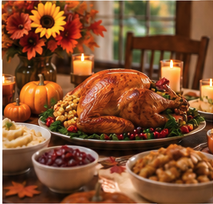

Thanksgiving is one of those holidays where we are instructed what to feel: Be grateful! Count your blessings! Savor what’s good! And, sometimes, everything does fall into place, and the day is a happy one to connect with loved ones, enjoy yummy food, and share laughter.
We’re reminded of the famous Thanksgiving painting by Norman Rockwell depicting Grandma serving a beautiful turkey with family and friends sitting around the table, broad smiles of delight on their faces. No one has an eating disorder, mom and dad are not getting divorced, and no one is feuding over politics or money. A perfect picture! A perfect Thanksgiving!
We all yearn for that perfect Thanksgiving with loving family and friends and the pleasure and safety of belonging. But, sometimes, real life just doesn’t measure up. And, let’s add, it often doesn’t measure up for many people. If that’s the case for you, you are not alone!
If you struggle with emotional eating, overeating, bulimia or body image concerns, the prospect of facing a large holiday meal may trigger the following worries:
Here are some supportive strategies to get through the day with kindness and self-compassion.
We need to challenge that self-sabotaging inner critic and remember we are doing the best we can with the cards we have been dealt.
People only change through self-acceptance and as they learn to become as kind to themselves as they are to others.
Joanne Gerr is a psychotherapist in Manhattan and Highland Park, N.J. She specializes in working with individuals, couples, and families on issues related to food/weight/body image, communication difficulties, anxiety, and seasonal affective disorder. Joanne will help you attain your personal goals through an individually designed treatment plan. We will work together as a team to help you have a more serene, joyful life with less anxiety or conflict.
In addition to her practice, Joanne has appeared as the psychotherapy expert on national television and radio. She lectures to professionals and the public in a variety of settings including Harvard University, School of Public Health as well as teaching at the University of Michigan where she was the recipient of The University of Michigan scholarship and won a National Communal Service Award for programs she developed for students and the elderly. She has presented at professional conferences including The American Psychological Association and The National Association of Social Workers. Joanne has also lectured for the 92 Street Y, Celebrity Cruise Lines and Canyon Ranch Spa in Massachusetts and Arizona. She continues postgraduate training at Harvard Medical School’s Department of Psychiatry.
Joanne would be delighted to hear from you.
Phones: 212-750-8130 or 732-247-5112
Text: 917-301-5244
Email: joannegd@gmail.com

October is a lovely month, cool and crisp. Many people relish fall foliage and apple picking knowing that winter doldrums are not far behind.
For people who struggle with binge eating, bulimia and other eating disorders, Halloween candy, donuts and other sugary treats appear everywhere we turn, and handling all these sugary foods can be extremely challenging. Mothers of young children often talk about the difficulty of this holiday and worry about what trick or treat candy to buy that won’t trigger them to mindlessly overeat or binge.
For years I have heard from mothers who, after finally put their children to sleep who were often keyed up from the excitement of the day and all the sugar they ate, would find themselves binging on the candy their children collected. These “mom binges” sometimes go on for the better part of a week, while they dole out to their children just a few pieces a day. They look forward to the day they can throw out the tempting stash.
We need to strategize how to handle this holiday especially for emotional eaters:
1. Remember, in this very complex world in which we live, Halloween offers a sense of levity. This is a day for our inner child to have fun, whether we are 8 or 48. If we choose to wear a costume, perhaps we can let go and be playful. We have permission to act silly and withdraw from some of our adult responsibilities or challenges of the world in which we live.
2. Your strategy for enjoying the day depends on what kind of eating issues you have. Are you a fairly “normal eater” who sometimes overeats or binges, or a bulimic, an anorexic or a food addict? If you are a fairly normal eater, you may want to pick out some of your favorite treats and enjoy them without guilt, as a part of a fun day. If you are bulimic and know that Halloween candy presents a potential binge fest, you need to decide if the “first bite is too many and then it’s never enough” or if depriving yourself will only backfire and set you up a binge. If you are a food addict, you need to attend to your vulnerability and get all the support you need to stay the course of your recovery. If you are anorexic, the key is not to overly restrict out of fear. Choosing the route you think will bring you the most joy and serenity is the key. Whichever path you take, enjoy the festivities without falling prey to food being the only focus of the celebration!